
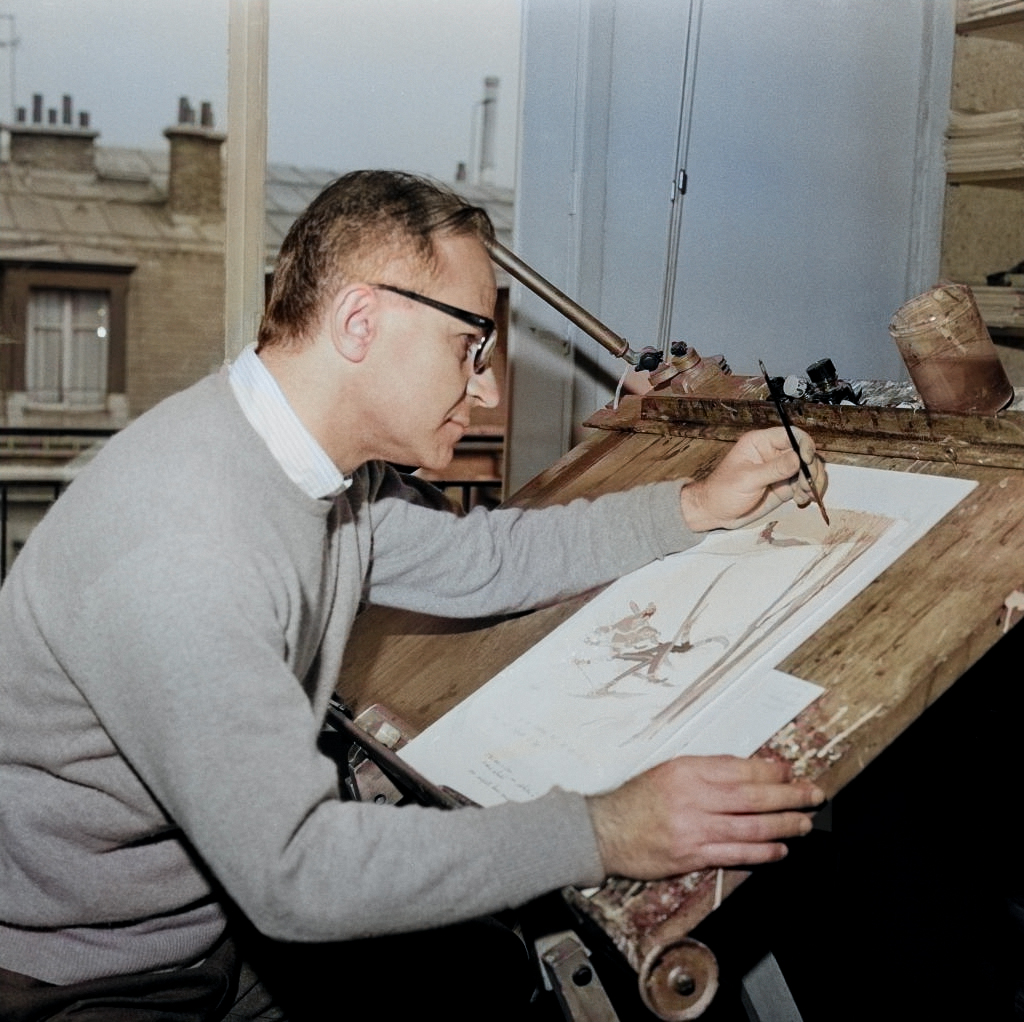
Edmond Kirazian
Kiraz - Designer
25/08/1923 _ 11/08/2020
Edmond Kiraz was born in Cairo, Egypt, on August 25th, 1923.
He was a student at the Frères des Écoles Chrétiennes middle school and started to paint by duplicating a 17th century Italian painting. Legend has it that this first attempt was unanimously considered as display of mastery. A talent was born.
At the age of nineteen, after passing his final exams, Edmond went to work at a bank to please his mother. He only lasted seven days. The story goes that he was so bored there that he passed the time drawing sketches on the bank ledgers. Kiraz then developed a love for the work of the illustrator David Low, who published his cartoons in the legendary Daily Mail. It is not unreasonable to think that his vocation as a newspaper cartoonist began at precisely this moment since he at that time submitted his first drawings to the newspaper in Cairo, which were trenchant caricatures in which he settled scores with Hitler, Stalin, and some notoriously corrupt members of the Egyptian government.
At the end of the war, when the guns finally fell silent, the young Kiraz had already made quite a nice reputation for himself. For a time he continued his work in Egypt before becoming eager to move on. He first wanted to go to America, but his visa was rejected. “Undesirable.” In the end, it was in Paris, France, where a bit by chance he came to lay down his hat. This was in October 1946. Kiraz was twenty-three years old.
A friend put him up for a spell at her place on Avenue Montaigne. Kiraz began wandering about the neighborhood, spending time on the terraces of its chic cafés and brasseries and gradually absorbing its lifestyle.
Quickly running out of money, he returned to Cairo for several months, but tried his luck again in Paris in 1948. He soon sold his first cartoons based on the burning issues of the day to the now defunct newspaper La Bataille. Kiraz then rented a modest room in a small building on Rue La Bruyère. He made Montparnasse and Saint-Germain-des-Prés into his permanent stomping grounds.
In 1955, he found a stable position in the columns of Ici Paris where he worked for a time on cartoons inspired by American comics, before creating his Carnet de Belles newspaper cartoons. At the age of thirty-two, Kiraz started to focus on women: young, active, modern, emancipated, breathing life into their time.
Having grown up under different skies, he was moved by the charm and effervescence of the Parisian lifestyle, and was equally fascinated by the young women who strolled in front of the café terraces where he innocently sipped his coffee.
"When I find myself staring at a blank page, I go down to the streets and come upon yet again my charming models as well as my inspiration. The streets are their domain.”
In 1959, Kiraz was thirty-six years old. He had a consequential encounter with Marcel Dassault. This passionate newspaperman and industrialist obviously knew Kiraz’s Carnet de Belles cartoons. He wanted to take a chance on the talent of this young cartoonist as a way to ensure the success of his weekly newspaper Jours de France. Their collaboration lasted thirty years, during which time Kiraz worked at a frantic pace, with their relationship only coming to an end upon the death of the industrialist.
Through the years, the two men developed a relationship based on mutual respect and admiration. If the legend is to be believed, Marcel Dassault appreciated Kiraz's cartoons so much that he waited in person in the newspaper’s entrance hall for the courier who delivered them each week. Dassault even gave Kiraz the option of publishing his cartoons in color and not just in black and white.
It was during this intensely creative period that Kiraz's young women turned into Les Parisiennes.
Beautiful, elegant, superficial, impish, grouchy, bratty, insolent, always on the cutting edge of fashion, full of charm and wit... his “dragonflies” as he liked to call them were quick to captivate the public. Over time, more than 250,000 of these young ladies, so similar, yet so different at the same time, found a home between the columns of Jours de France. Resolutely modern, a bit brazen, constantly demanding their absolute freedom, thanks to their shock phrases and pencil-thin figures they remained the most true-to-life heroines embodying eternal, triumphant femininity.
In 1970, Les Parisiennes left the French capital and crossed the Atlantic. Taking advantage of a long stay in the United States, Kiraz made every effort to ensure that Hugh Hefner, the founder of Playboy Magazine, saw his cartoons. His efforts paid off: the scandalous newspaperman fell under the charm of the Les Parisiennes and welcomed them into the columns of his magazine alongside his voluptuous Playmates.
Soon, Les Parisiennes became advertising icons. Renault, Perrier, Parker, Nivea, Monoprix, Scandale, and more went crazy for them. But the one that left the biggest mark on everyone's mind was no doubt the Canderel ad campaign for which Frédéric Beigbeder went into the Kiraz archives and wrestled away a few illustrations that remain famous to this day.
“What's the matter? You've never seen a girl take a Canderel?”
In May 2008, Kiraz's dragonflies, forever loyal to the Parisian mindset that characterizes them, made their way into the most Parisian of museums and cemented their famous adventures into the history of the city. The exhibition at the Carnavalet Museum gave Parisians the chance to discover - or rediscover - all of Les Parisiennes in all their outfits. Original gouache-paint illustrations, unseen paintings, drawings, feature articles, sketches, photographs, press clippings, advertising posters... More than 230 works, documents, and archives making up the first retrospective of the artist's work. The exhibition recorded up to 3,000 entries on some days, and was ranked as the second largest in terms of attendance during the 2008 Night at the Museums. Kiraz was in attendance, tremendously delighted to meet fans of all ages.